1925, Paris. The International Exhibition of Modern Decorative and Industrial Arts opens along the Seine, from the Grand Palais to the Invalides. One hundred and seventy-two pavilions, one firm rule: no historical pastiche, every piece must be original. That event sets the language critics will later call Art Deco. And in the decade that follows, between 1925 and 1939, the travel poster reaches its peak. Fourteen years, perhaps fifteen, in which a handful of Paris draftsmen will produce the most beautiful tourism posters ever printed.
The phrase "golden age" is sometimes overused. For that period, it fits. Three conditions line up: a powerful editorial system (the great French and foreign railway companies, the transatlantic liners, the nascent airlines, all commission posters at a sustained pace), a generation of draftsmen trained at the Académie Julian and the École des arts décoratifs, and an urban audience that travels for the first time in numbers. The travel poster has become the most effective advertising medium of its time.
Cassandre, and the others
Cassandre, the name is known. Adolphe Mouron in reality, born in Kharkov in 1901, he becomes the reference poster artist as early as 1923 with Au Bûcheron, the sign for a Paris department store. In 1927, the Nord Express lays down his complete grammar: flat color planes, geometric typography, compressed perspective. We have a separate article devoted to him. This text is rather about the ecosystem in which he worked.
Roger Broders, for instance. He signs between 1922 and 1932 more than eighty posters for the Paris-Lyon-Méditerranée (PLM) railway company. His skiers in mid-flight, his bathers at Juan-les-Pins, his cars speeding along the Promenade des Anglais defined the tourism imagery of the Riviera and the Alps for two generations. His technique: lithography in six to eight colors, separations prepared by hand with colored pencil, transparencies set one by one on the stone.
Charles Loupot holds an intermediate position between pure advertising and auteur poster work. He draws for Lufthansa, for the Côte d'Azur, but also for Saint-Raphaël and Valentine. He signs the poster for the Swiss Centennial in 1939, which symbolically closes the period. Jean Carlu, more political, alternates commercial campaigns and engaged posters (the Spanish Civil War, then American propaganda during the Second World War). Roger Soubie, less cited today, is one of the most prolific: several hundred posters for cinema, theater and tourism, signed between 1925 and 1955.
The subjects: liner, train, mountain, beach
The Art Deco travel poster organizes itself around four dominant subjects. The transatlantic liner, almost always treated head-on or in a low-angle dive, takes up most of the composition. The sea appears only as a thin line of horizon. The ship itself is monumentalized: vertical prow, symmetrical funnels, crushed scale. Cassandre with the Normandie in 1935 sets the model that will never be surpassed.
The night train (Wagons-Lits, Pullman, Orient Express) plays on speed and light. The rails converge to a vanishing point, telegraph lines rhythm the sky, the sky is usually at dusk (deep blue, red, orange). Mountains and beaches belong, on the other hand, to another register: no longer transport images but destination images. The skier in mid-flight, the bather in a two-piece on yellow sand, the checkered tablecloth of a seaside picnic.
A good poster, Cassandre said in 1931, reads at thirty meters and is understood at ten.
The 1939 break
The golden age stops in September 1939. The declaration of war immediately suspends tourism commissions. Several railway companies are requisitioned. French poster artists scatter: Cassandre leaves for New York, Carlu for the United States, Broders retires to Paris. After 1945, posters resume but the style changes. Mass travel, airlines on the rise, color photography in magazines: these 1950s novelties will gradually erode the monopoly of painted illustration. The end of the golden age is clean.
Eighty years later, posters from that period have become collectors' items. A Broders in good condition trades between 800 and 3,000 euros depending on the destination and the state. A Cassandre original, like the Normandie, can exceed 15,000 euros. The market has been structured since the 1990s, with regular thematic sales at Artcurial and Millon in Paris, at Christie's in New York and London.
Why the genre is coming back
Since the end of the 2010s, the Art Deco travel poster has been having a discreet but real revival. Three causes. The visual exhaustion of saturated contemporary decor, which makes the Art Deco language, economical and legible from a distance, useful in heavily loaded interiors. The arrival of quality reproductions, colors calibrated on the originals, which make these works accessible. Finally, generational transmission: collectors from the 1990s pass their posters down to their children.
To start a selection: a large format of a liner or a night train as the central piece, two or three medium formats of mountain or beach as satellites, all in the same frame, matte black or natural oak. For the wall, a light tone, off-white or pearl gray. A dark ground stifles the skies of travel posters, which were designed to breathe.
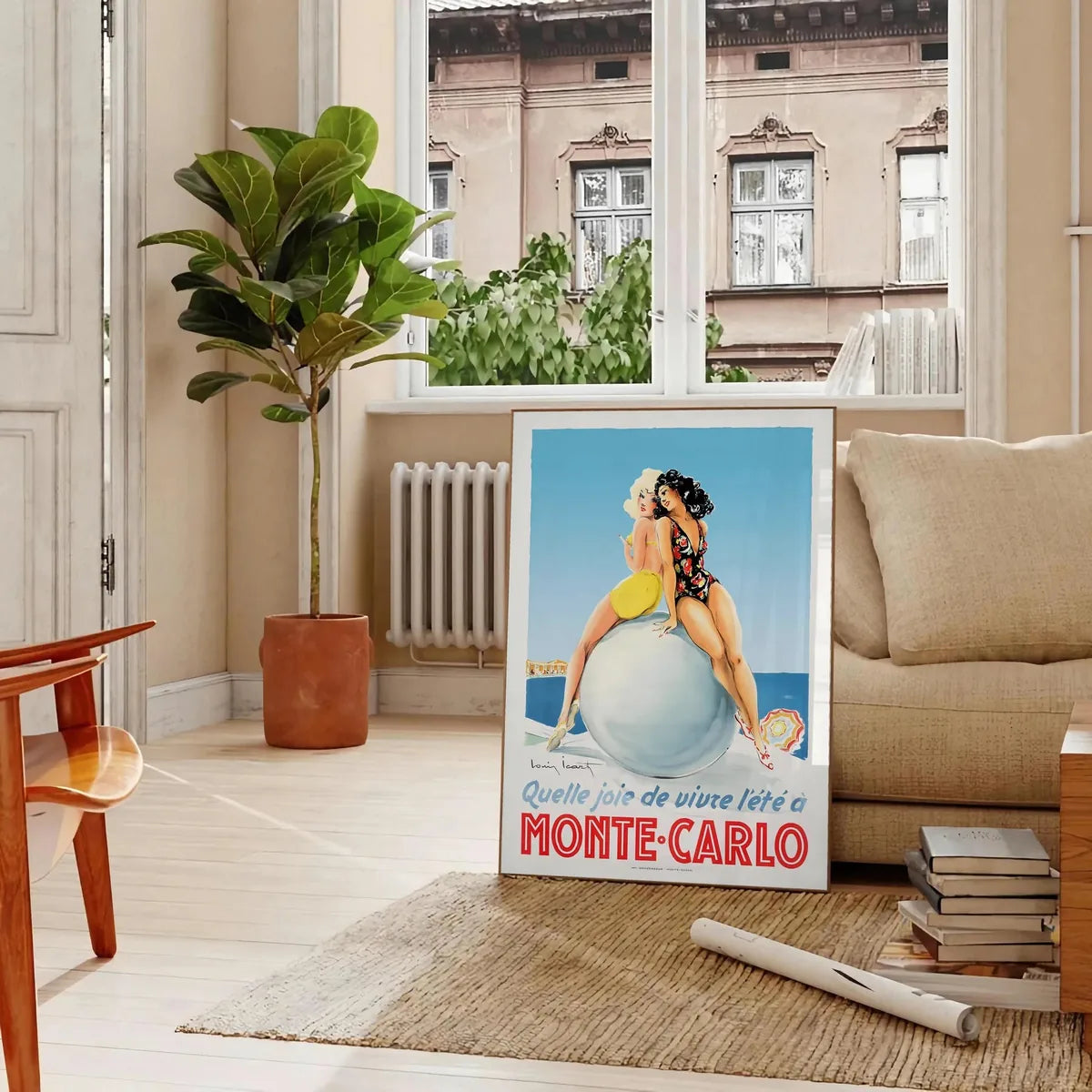
At Montmartre Poster, the vintage travel collection brings together a tight selection of posters from the 1920-1950 period, including several reworkings of the great PLM commissions. The Art Deco collection broadens the view to the style as a whole, from liners to perfume brands, including the period's advertising compositions. We also keep a dedicated article on Cassandre himself for anyone who wants to go deeper into the singular case of the decade's reference poster artist.