Edo, around 1831. Katsushika Hokusai is 71, signs his plates from now on with the pseudonym "the old man mad about drawing", and has just delivered to his publisher Nishimuraya Yohachi the third plate of a series he titles "Thirty-six Views of Mount Fuji". The plate is numbered thirty-third in the later sequence of prints, but it is the one that will remain: "Under the Wave off Kanagawa". Three fishing boats crushed by a monstrous wave, Mount Fuji tiny at the bottom of the trough, a sky of dusty grays. Two centuries later, the motif has become the most reproduced Japanese image in the world.
Hokusai was born in 1760 in Edo, in the working-class district of Honjo. He starts drawing at six, becomes an apprentice to the engraver Nakajima Ise at fourteen, then to the printmaker Katsukawa Shunshō at eighteen. He changes name about thirty times in the course of his life, signing in turn Shunrō, Sōri, Tatsumasa, Taito, Iitsu, Manji. That inflation of signatures, rare even among ukiyo-e artists, points to an obsession: starting over with each period, never settling into a commercial style. He dies in 1849, at 88, after producing more than thirty thousand drawings, prints and book illustrations.
Ukiyo-e, a collective craft
A Hokusai print is never the work of one person. The technique is collective and strictly hierarchical. The artist, the "eshi", draws in ink on thin paper. An engraver, the "horishi", transfers the drawing onto blocks of hard cherry wood, one block per color, ten to fifteen blocks for a carefully made piece. The printer, the "surishi", brushes ink onto each block, lays the damp paper, rubs with a baren, that braided bamboo disk that delivers a controlled pressure. Each impression is a perfect manual register. The "Great Wave" was printed in several thousand copies between 1831 and 1835, which makes it rare in good condition but widely circulated in its own time.
Prussian blue changes everything. Imported from Germany via the Dutch trading post at Dejima from the 1820s on, that stable synthetic pigment, unfading under light, transforms the ukiyo-e palette. Hokusai makes its most spectacular use with the "Great Wave": the intense blue of the troughs, the relief of the foam, the contrast with the pale sky. Before Prussian blue, prints used fragile plant-based blues that turned gray within two decades. After it, blue becomes the graphic signature of Japan, all the way down to our contemporary reprints.
European Japonisme, 1860-1900
1854. The American commodore Matthew Perry forces, at gunpoint, the opening of Japanese ports to Western trade. In the twenty years that follow, tens of thousands of prints reach Europe, often as wrapping paper for export porcelain. Paris dealers notice them first. Siegfried Bing opens in 1875 a gallery on rue de Provence, called "L'Art Nouveau", which will sell to Vincent van Gogh, Claude Monet, Pierre Bonnard, Mary Cassatt. The effect on European painting is immediate. Van Gogh copies in 1887 three prints by Hiroshige. Monet builds his Giverny garden as a Japanese garden, with its bridge, its water lilies, its irises. Toulouse-Lautrec invents the modern poster by drawing directly on ukiyo-e composition.
"If heaven gives me five more years," Hokusai said at the end of his life, "I will become a true painter."
Living with a print on the wall
A Hokusai print or its contemporary tribute calls for a simple frame. No baroque, no gilding, no carved molding. The rule that works: a light wood frame, oak or ash, a thin profile, no patina. The natural wood recalls traditional Japanese furniture and echoes the original support. A matte black frame also works, especially on a very white wall, but it gives a more contemporary, almost museum reading. The four-centimeter cream mat is essential: it separates the image from the frame, gives it air, recalls the white margin of Hokusai's paper. Without a mat, the print blends with its frame and loses the sense of depth.
Size matters. The original "Great Wave" measures about 25 by 37 centimeters, an intimate format made to be held and looked at close. A larger reproduction, 50 by 70 or even 70 by 100, changes the register of reading: what was a table object becomes a room object. Both options are defensible. In small format, hang it in a corridor, near a reading chair, at the eye level of someone sitting. In large format, set it above a low sofa or a TV unit, in a quiet, light-toned room.
Three starting points
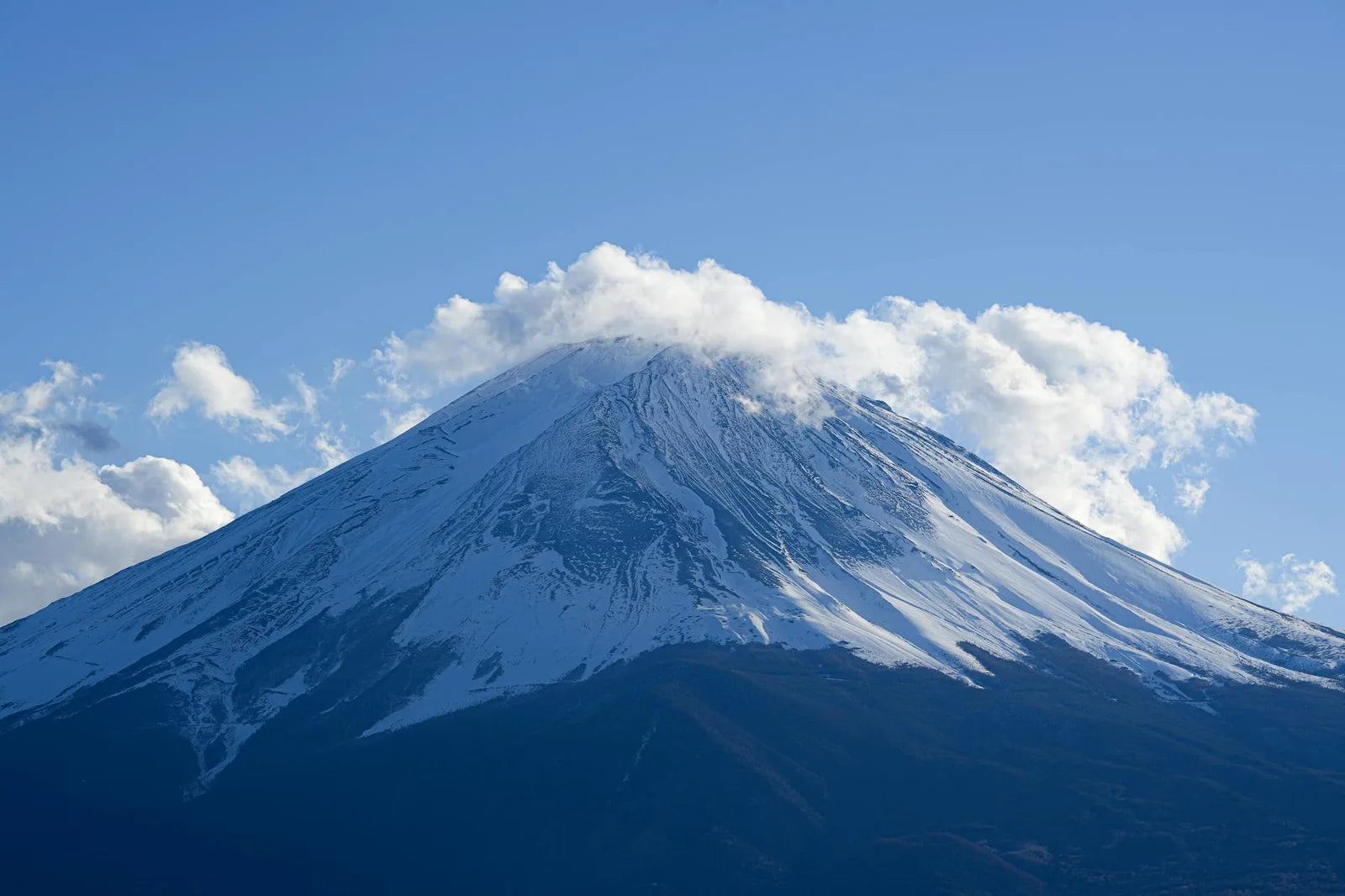
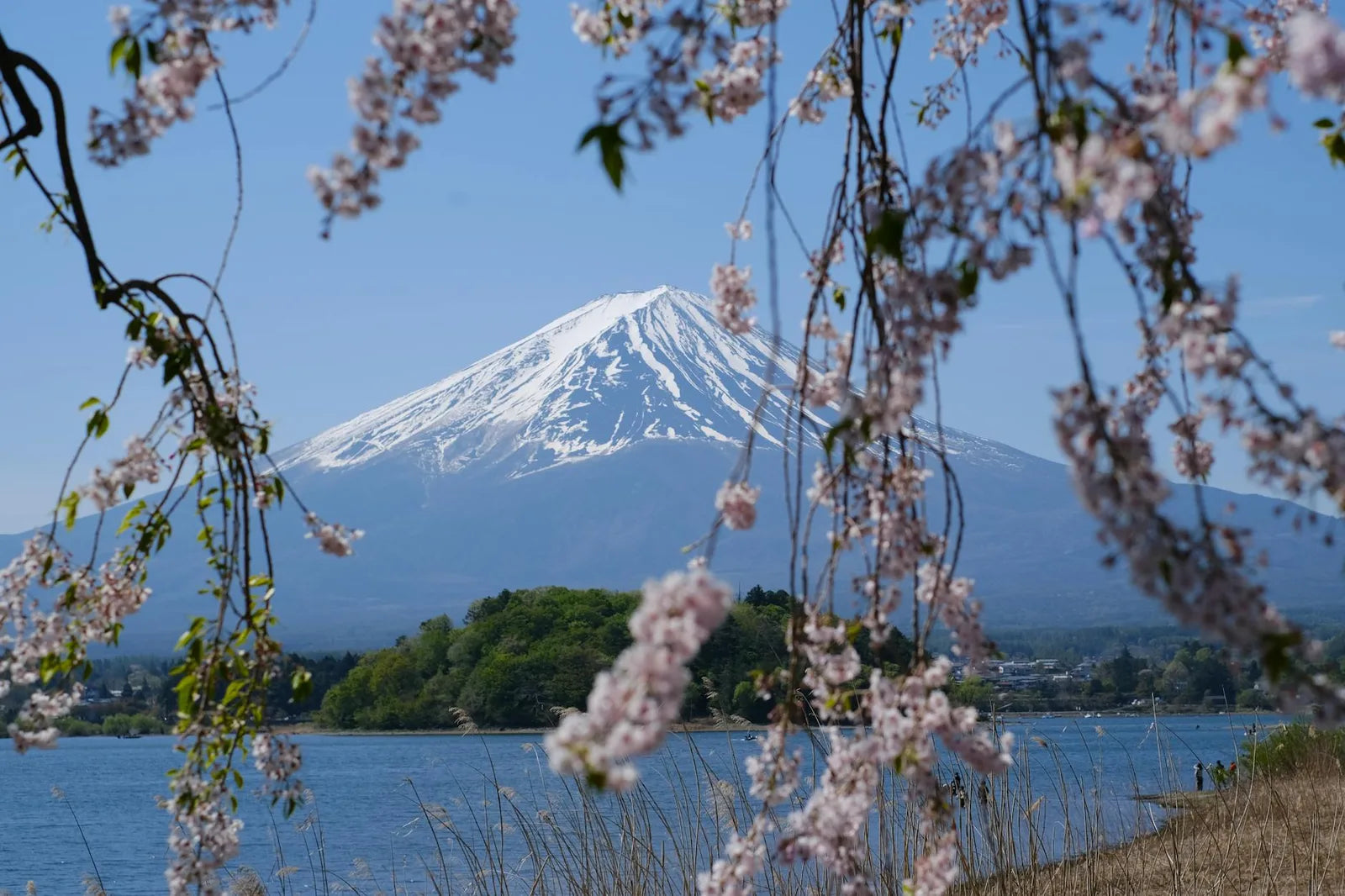
- A view of Mount Fuji: the founding plate, the most solid subject of the series. Intimate format, oak frame, cream mat.
- A landscape by Hiroshige, his contemporary: the bridges, rains and passes of the Tōkaidō. A softer, more narrative reading, ideal in a bedroom.
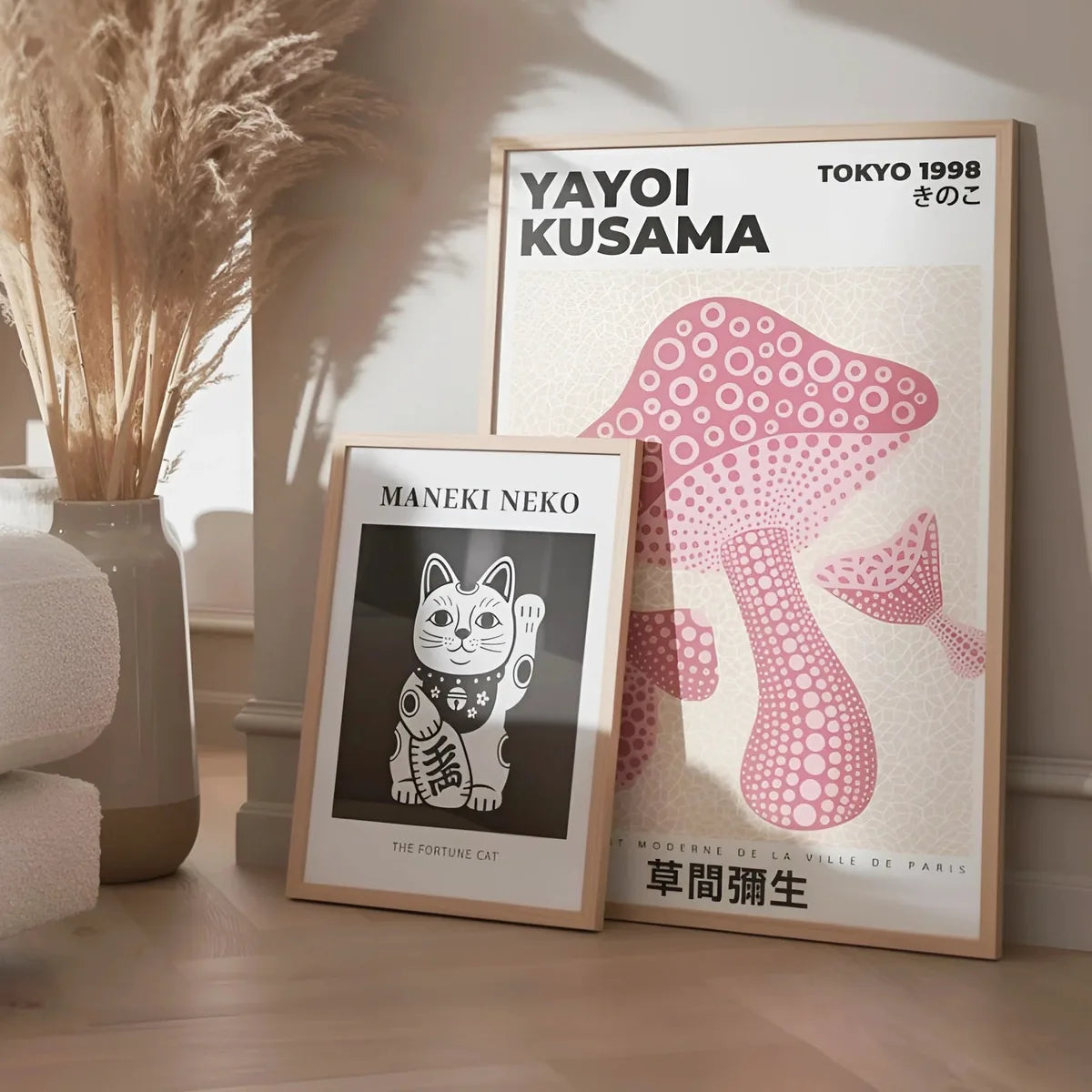
- A contemporary take on ukiyo-e language (Yayoi Kusama, Foujita, current Japanese illustrators). The bridge between Edo and our time, in a Japonisme selection that spans three centuries.
At Montmartre Poster, the Japonisme collection brings together ukiyo-e prints, their European echoes (the whole first Parisian Japonisme wave of 1880) and their contemporary extensions. To go further on the circulation of these images between Edo and Paris, see our article Japonisme, three centuries of Japanese graphic design, which carries the "Great Wave" thread forward to Yayoi Kusama.