Milan, December 11th 1980. Ettore Sottsass, 63, an Olivetti star designer for thirty years, gathers in his via Manzoni apartment seven young designers: Michele De Lucchi, Aldo Cibic, Marco Zanini, Andrea Branzi, Matteo Thun, Martine Bedin, Nathalie Du Pasquier. A Bob Dylan record is on a loop on the hi-fi. Side B closes on "Stuck Inside of Mobile with the Memphis Blues Again". The word Memphis comes back. Sottsass suggests calling the group Memphis Group. No one argues. The program fits in one sentence: design furniture and objects that refuse the rigorous modernism of the Bauhaus and Dieter Rams. The group wants color, pattern, decoration, cheap colored laminate, asymmetric shapes, gloss. The opening piece is a shelf Sottsass designs in two weeks: "Carlton", a vertical tower in colored laminate with shelves that look like shards of material. It is shown at the Milan Furniture Fair in September 1981. Media reception is global, and the scandal is just as fast.
Sottsass is no beginner. Born in 1917 in Innsbruck, trained at the Turin Polytechnic, he spent the 1950s designing Olivetti interiors, signed in 1969 the portable typewriter Valentine (lacquered red, deposited in every MoMA on the planet), and took part in 1972 in the exhibition "Italy: The New Domestic Landscape" at MoMA New York. He is known, respected, regarded as one of the great masters of Italian design. His break in 1980 is calculated. He considers the rigorous modernism of the 1960s-1970s, with its gray and black palette, pure geometry, claimed functionality, has become a worn-out dogma. Memphis wants to break that dogma, bring back pleasure, color, irony. It is, in design, the equivalent of what Warhol did to painting twenty years earlier.
Seven years, three hundred pieces
The movement officially runs from 1981 to 1987. In seven years, the group produces about three hundred pieces: furniture (shelves, armchairs, tables), lighting, ceramics, textiles, wallpapers, printed patterns. All pieces are edited by Memphis Milano, the company founded to distribute the movement. Sales are modest (pieces are expensive, the audience is narrow), but the influence on global graphic design is massive. Karl Lagerfeld furnishes his Monte Carlo apartment entirely in Memphis, and David Bowie collects several dozen pieces. The Memphis palette (chewing-gum pink, turquoise, lemon yellow, black, white, polka-dot and zigzag patterns) spreads through the decade: it shows up in MTV music videos, in video-game graphics, in record sleeves for Duran Duran and Madonna, in TV opening titles.
The colored terrazzo is emblematic. Originally an Italian floor finish made of small stones embedded in cement, Memphis reinterprets it as a printed pattern on laminate, fabric, paper. Sottsass names it "Bacterio", and the pattern becomes the visual signature of the movement. Nathalie Du Pasquier, the youngest of the group, signs most of the textile motifs. She designs in 1982 dozens of fabrics with geometric patterns: "Cerchio", "Gabon", "California". Those motifs come back in fashion and decor up to today: every "1980s" capsule collection from a high-street brand revisits those fabrics, sometimes credited, sometimes not.
Sottsass leaves, Memphis dissolves
Sottsass announces his retirement from the group in 1985. He is 68 and finds that the movement, now a commercial brand, has lost its original irony. Memphis Milano keeps going until 1987 and then dissolves. The pieces produced over those seven years quickly become collectibles. An original "Carlton" shelf trades today between 8,000 and 15,000 euros at Wright in Chicago, at Phillips in London. A De Lucchi "First" armchair sits around 6,000 euros. The textile motifs have been re-edited since 2014 by Memphis Milano, which holds the rights. Sottsass dies in Milan in December 2007 at 90, having kept working as an interior architect to the end.
"Design," Sottsass wrote in 1981, "is not for solving problems. It is for inventing them."
Living with a Memphis poster
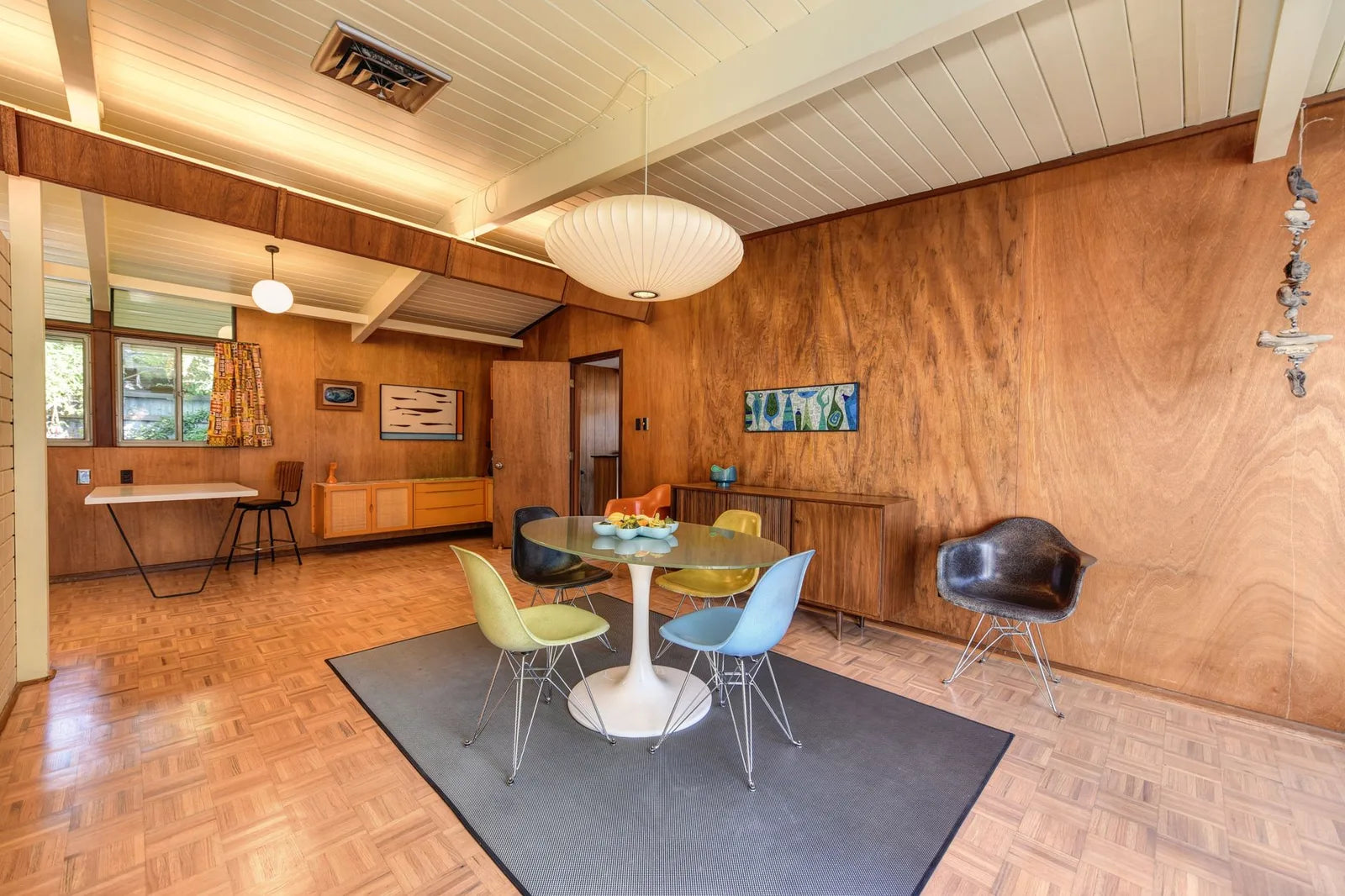
A Memphis-language poster wants a clear wall, a contemporary environment, and a lot of neutral around it. The motifs are already dense by themselves: adding a colored wall, a patterned sofa, or another strong work, is visual death. Pick a white or cream wall, a plain sofa, minimalist furniture. The room then becomes a frame for the composition. The frame: thick matte black, holding the composition and playing contrast with the bright colors. Oak works poorly, it softens the palette one wanted precisely to celebrate. Size matters: those patterns were made for objects or large surfaces of fabric, so they work in large poster format (70 by 100 and up). In small format, they look cramped, like a swatch.
The ideal decorative environment is on the other hand fairly open. Memphis pairs well with light Scandinavian furniture (the palette contrast is the draw), with mid-century modern (the familiarity of the geometric language ties the two), even with a classical interior provided the Memphis piece is isolated. It pairs badly with another saturated 1980s decor (the memory turns kitsch), with a Belle Époque or Art Nouveau poster (the palettes fight), and with a very dark interior (the composition loses readability). A light wall, natural light, neutral furniture: the room breathes.
Three threads to start with
- A Bacterio motif or colored terrazzo inspired by Sottsass. 70 by 100, thick black frame, white wall.
- A geometric composition inspired by Nathalie Du Pasquier's textiles. Softer, more accessible, ideal in an office or a teenage bedroom.
- A contemporary modernist tribute in the modern abstract collection, whose geometric spirit dialogues with the Memphis language.
At Montmartre Poster, tributes to 1980s colorful design and more broadly to postmodern grammar live in the modern abstract collection. For the lineage from the Bauhaus to pop art and then to Memphis, see our articles on the Bauhaus and on pop art, which describe the steps of that circulation from modernism toward ironic decor.