1941. Henri Matisse is 71 years old. He undergoes a serious abdominal operation in Lyon, followed by complications. For two months, his life is feared for. He comes out weakened, unable to hold a brush for long. He can no longer spend his days at the easel. He must invent something else.
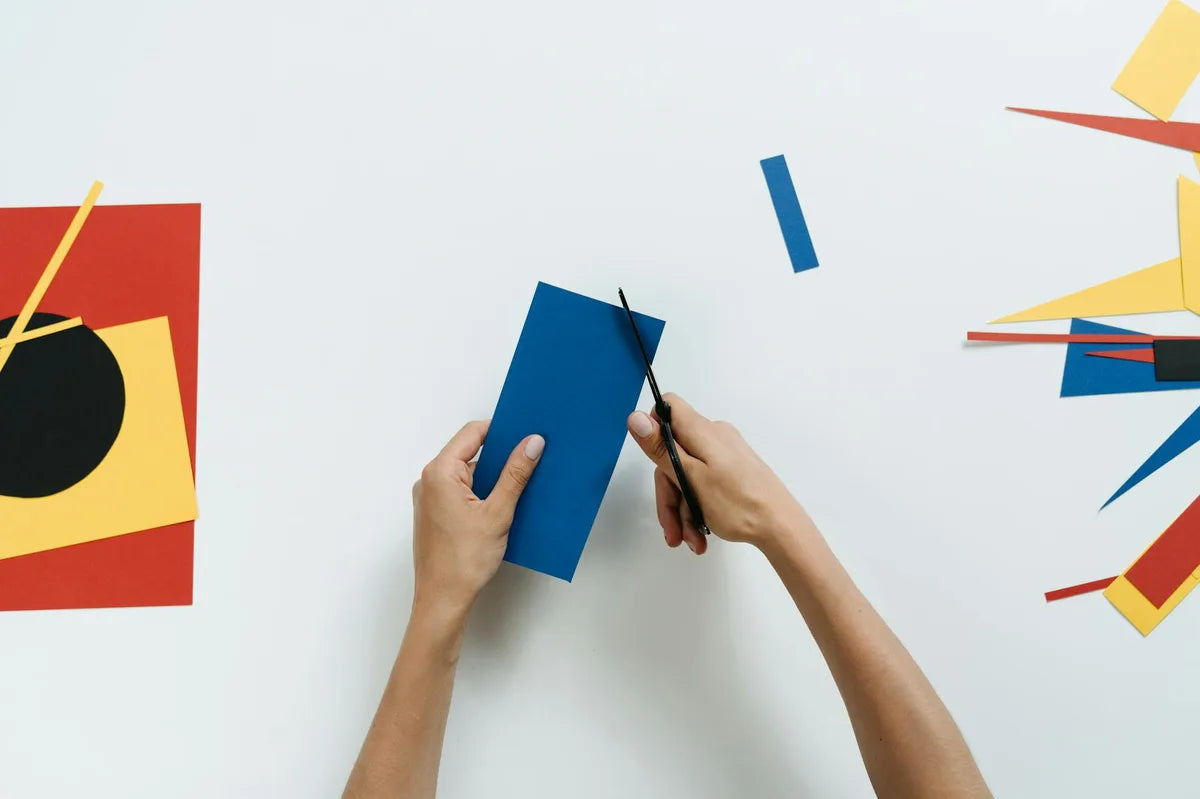
It is in the six years that follow, and more particularly between 1947 and 1954, that Matisse develops what he calls the technique of cut-out papers. The principle is simple. An assistant (Lydia Delectorskaya, his close collaborator, or later Paule Martin) applies gouache in large flat areas on sheets of white paper laid flat on the studio floor. Matisse, seated or half lying down, then cuts these sheets with a pair of watchmaker's scissors. The fragments are pinned to the wall, moved, recomposed. When the composition is right, the assistant glues the pieces onto a cardboard backing.
Jazz, the First Book
1947. Teriade publishes "Jazz", a book of twenty plates signed by Matisse. All are derived from cut-out papers: "Icarus", "The Horse, the Rider and the Clown", "The Toboggan", "Pierrot's Funeral". The format is large (40 by 60 centimetres), the stencil printing respects the thick texture of the gouache. Matisse accompanies each plate with a handwritten text, a facsimile of his handwriting, in which he comments on colour, memory, composition.
The book is considered today one of the most beautiful artist's books of the 20th century. Original copies (270 numbered, signed, justified) change hands at public auction at around 80,000 euros. But the effect of Jazz goes beyond the book. It is the first time Matisse presents this technique as a work in its own right, not as a working stage.
The Vence Chapel (1948-1951)
In Vence, in the hinterland behind Nice, Dominican sisters decide to build a new chapel. Matisse, whom they nursed during his convalescence, agrees to design the entire decoration. He is 78 years old. He will work for three years, designing the stained glass windows, the chasubles, the ceramic wall panels, the liturgical furniture. The stained glass windows are designed like cut-out papers: three colours (yellow, green, blue), simple shapes, light that projects colour onto the white walls.
The chapel is consecrated in June 1951. Matisse, bedridden, does not attend the ceremony. He will consider this commission his masterpiece. The chapel still exists, open to the public in Vence, and the southern light plays every afternoon with the coloured flat areas.
"I believe I have reached my definitive form," writes Matisse in 1948. "Scissors can give more sensitivity to line than pencil or charcoal."
The Late Works (1952-1954)
"Blue Nude II" (1952): female silhouette in ultramarine blue flat, spiral posture, paper height 117 centimetres. "The Snail" (1953): concentric composition of coloured squares, on a white background, almost 3 metres by 3. "The Sadness of the King" (1952): a coded self-portrait, the king is Matisse himself, lying down.
Matisse dies on 3 November 1954, in Nice, at the age of 84. He spent the last seven years of his life cutting paper. What he invented during that period, graphic design has been digesting for a century: all the design of the 1950s and 1960s owes something to Jazz, to Vence, to the Blue Nudes.
Our reproductions on 275 g/m² art paper respect the original colours as preserved by the Musée Matisse in Nice and the Centre Pompidou in Paris. Paper density matters: Matisse always chose thick supports with a sensitive texture, and that is what we seek to recover in printing.