In 1896, Privat-Livemont, a 33-year-old Belgian poster artist, received a commission from the Absinthe Robette house in Brussels. He delivered a poster that would become one of the most famous of Art Nouveau: a woman in a white dress holding a glass of green absinthe, surrounded by plants with organic curves, against a night-blue background. The style is directly inherited from Alphonse Mucha, but the composition has a more direct sensuality. Absinthe was at the time under moral and political pressure, and the poster plays on the forbidden.
This is a constant of the alcohol poster: it plays on desire and pleasure rather than information. Unlike a railway poster that sells a destination and must convince of a concrete journey, a spirits poster sells a sensation, a promise, a social belonging. It can therefore afford to be more allusive, more beautiful, more mysterious.
Absinthe, pastis and Aperol
Major poster campaigns for alcoholic drinks begin in the 1880s, with beer first, then aperitifs. Absinthe is the most frequent subject between 1880 and 1910. Jules Cheret makes several dozen. Toulouse-Lautrec depicts absinthe drinkers in his paintings as well as in his cafe-concert posters, where alcohol is ever-present in the background.
The ban on absinthe in 1915 opens a market for substitutes: pastis (invented in 1932 by Paul Ricard), vermouths, bitters. Each one commissions its own posters. Dubonnet is particularly famous: its 1930s campaigns, with the stylised character "Dubo-Dubon-Dubonnet" in three sequential posters, are signed by Cassandre. It is one of the first sequential advertising campaigns in history.
Campari and contemporary art
From the 1920s onwards, the Italian brand Campari begins commissioning its posters from renowned artists rather than commercial poster-makers. The strategy is clear: associate the brand with contemporary art to make it a symbol of sophistication. Fortunato Depero, Futurist artist, signs the Campari posters in the 1920s. The graphic design is radical: geometric shapes, primary colours, invented typography.
The 1921 Campari poster by Leonetto Cappiello shows a jockey on a vivid red background holding a bottle. It remained on display in the streets of Milan for over a year, and is considered today one of the best posters of the decade.
In today's decor
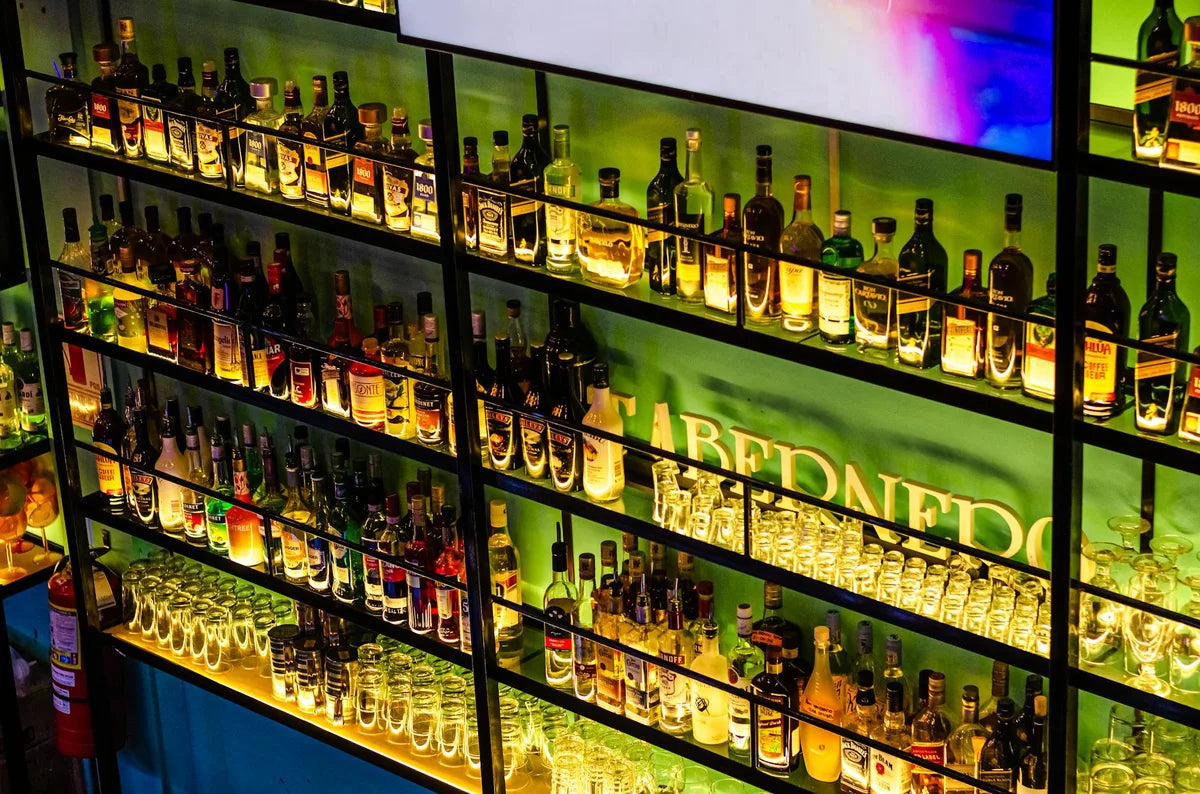
Vintage cocktail and spirits posters have a decisive advantage in contemporary interiors: they are made to be seen in spaces where people eat and drink. They have an energy and warmth that more sober posters lack. In a kitchen, a home bar, a relaxed dining room, a 1960s Campari poster or an Art Nouveau absinthe poster brings exactly the right amount of conviviality.
Our selection covers the period 1890-1970, with an emphasis on French and Italian posters. The chosen compositions are those that work as graphic artworks independently of the brand they represent: the brand may have disappeared, but the image remains beautiful.