Vienna, May 19th 1903. In a rented workshop on Neustiftgasse 32-34, the architect Josef Hoffmann, 32, the designer Koloman Moser, 35, and the industrialist Fritz Wärndorfer, 35, sign the statutes of the Wiener Werkstätte ("Viennese Workshops"). The program fits in one line: produce every everyday object - furniture, cutlery, fabric, wallpaper, bookbinding, jewelry, postcard - as a work of art. No hierarchy between the major arts (painting, sculpture, architecture) and the minor arts (goldsmithing, furniture, fashion). It is the Wagnerian idea of the "Gesamtkunstwerk", the total work of art, imported into industrial design. The workshop opens in June with seventeen craftsmen and capital from the Wärndorfer family. It runs until 1932, thirty years, and defines the entire aesthetic of Vienna Secession.
The context deserves a pause. Vienna in 1903 is the capital of the Austro-Hungarian Empire, a city of two million, one of the wealthiest in Europe. Sigmund Freud lives at Berggasse 19, a few minutes walk from the Werkstätte. Gustav Mahler conducts the Opera. Gustav Klimt has presided over the Vienna Secession since 1897. Egon Schiele is 13. Oskar Kokoschka is 17. Adolf Loos will publish "Ornament and Crime" two years later, in 1908. That cultural density is unique in Europe, and the Werkstätte plays a catalyst role in it. It provides the decor, the objects, the clothes, the jewelry of a cultured bourgeoisie that wants to live in a total aesthetic coherence. Commissions come from Viennese Jewish banking families (the Wittgensteins, the Mauthners, the Lederers), who have villas entirely decorated by the Werkstätte.
Palais Stoclet, Brussels, 1905-1911
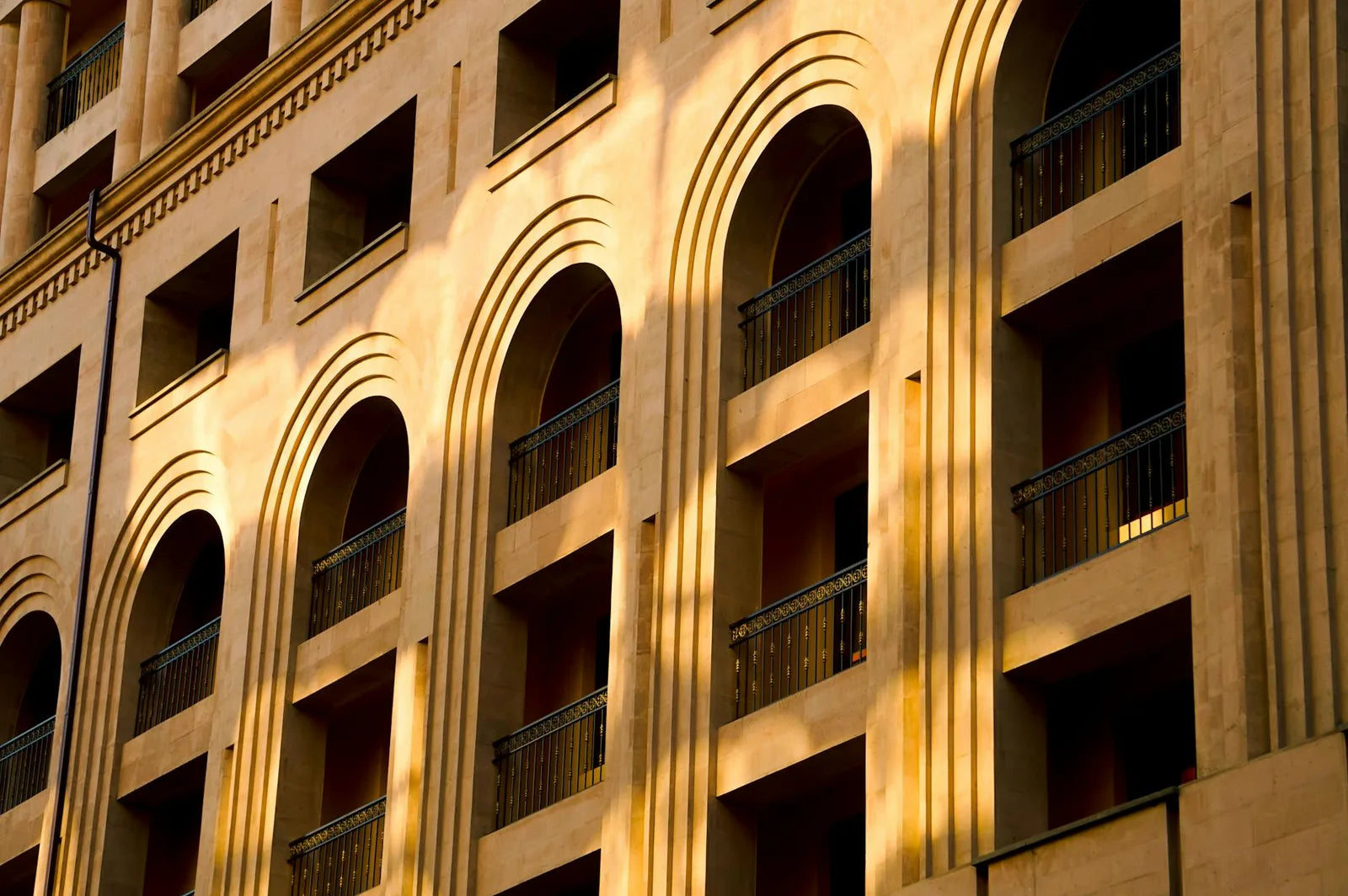
The emblematic early Werkstätte commission is the Palais Stoclet, built in Brussels for the industrialist and collector Adolphe Stoclet between 1905 and 1911. Josef Hoffmann designs the architecture, Koloman Moser contributes to the decor, and Gustav Klimt signs the fresco "The Tree of Life" that covers the dining-room walls. The building is a manifesto: a white marble facade outlined in bronze, interiors where every chair, every cup, every door handle is designed by the Werkstätte. It has been UNESCO World Heritage since 2009. It is private, closed to the public, and only a few photographs in circulation let one see the interiors. The Stoclet family has never agreed for it to become a museum, faithful to the original intention of a work of art to live in.
The visual grammar of the Werkstätte is recognizable at a glance. Rigorous geometry, restricted palette (black, white, gold, sometimes a deep blue), checkerboard or grid motifs, very marked verticals, typography drawn like objects. It is the first geometric grammar of the twentieth century, twenty years before the Bauhaus. Hoffmann signs in 1903 the "cube" tea service, made of pure geometric pieces in hammered silver. Koloman Moser designs in 1904 the "Cube" secretary, a writing table entirely gridded. The black-and-white checkerboard motif becomes such a strong visual signature that it shows up today in Scandinavian interior design, in fashion (Yohji Yamamoto, Issey Miyake), in contemporary graphic design. The bridge between Vienna 1903 and Stockholm 2025 runs through that grammar.
Klimt, the golden period and the workshop
Gustav Klimt is not a Werkstätte member, but he collaborates with it regularly. The Palais Stoclet fresco, finished in 1911, is his decorative masterpiece. It uses gold leaf massively, a technique Klimt learned from his father Ernst, a goldsmith. Klimt's "golden period" (1899-1907) culminates with "The Kiss" (1907-1908), now at the Österreichische Galerie Belvedere. That work, perhaps the most reproduced of the twentieth century after the Mona Lisa, shares with Werkstätte motifs the ornamental geometry, the golden palette, the flattening of composition. Klimt dies of a stroke in February 1918, at 55, in the middle of the Spanish flu epidemic. The same year, in October, Koloman Moser dies of cancer at 50. Egon Schiele dies at 28 the same week as Moser. Pre-war Vienna disappears in a few months. Hoffmann survives, keeps the Werkstätte going through the 1920s as best he can, but the golden age is over.
"Every age must have its own style," Hoffmann said in 1905. "Why should ours be the imitation of the past?"
Living with a Secession poster
A Vienna Secession exhibition poster, or its contemporary tribute to the Werkstätte language, calls for a refined environment. No grandiloquence, no chromatic saturation, no overloaded gallery wall. One piece, centered, on a light wall. The frame: a very pale oak, almost bleached, that echoes the black-white-gold palette of the composition. Matte black also works but hardens the read, which can suit a very contemporary wall. Avoid gold: doubled on itself, gold loses its decorative quality. Size matters: those posters were made for the windows of Secession exhibitions and the interior walls of bourgeois villas, so they work in medium format (50 by 70) rather than oversized. They were not made for the urban street wall, unlike Toulouse-Lautrec or Cassandre posters.
The ideal decorative environment leans toward modernized classical. The Werkstätte pairs well with light Scandinavian furniture (the geometric grammar is shared), with mid-century modern (the historical bridge is visible), and with a 1920s Art Deco interior (the two movements are related). It pairs poorly with French Belle Époque, plant-driven decor (the palettes fight), with saturated pop art decor (the chromatic subtlety is crushed), and with a too-dark wall (the black-and-white motifs lose their read).
Three threads to start with
- A Secession exhibition poster (geometric typography, checkerboard motif, gold ground). 50 by 70, pale oak frame.
- A pure Werkstätte motif (black-and-white grid, geometric pattern). More radical, best in a minimalist room.
- A Klimt golden-period tribute, in the vintage collection. The bridge between gold and geometry is immediate.
At Montmartre Poster, tributes to Vienna 1900 and the Wiener Werkstätte live in the vintage collection and in the Art Deco collection. To follow the bridge between Vienna and Parisian Art Deco, see our article Art Deco, the birth of a total style. For the ornamental lineage, see also our note on Mucha and Art Nouveau.