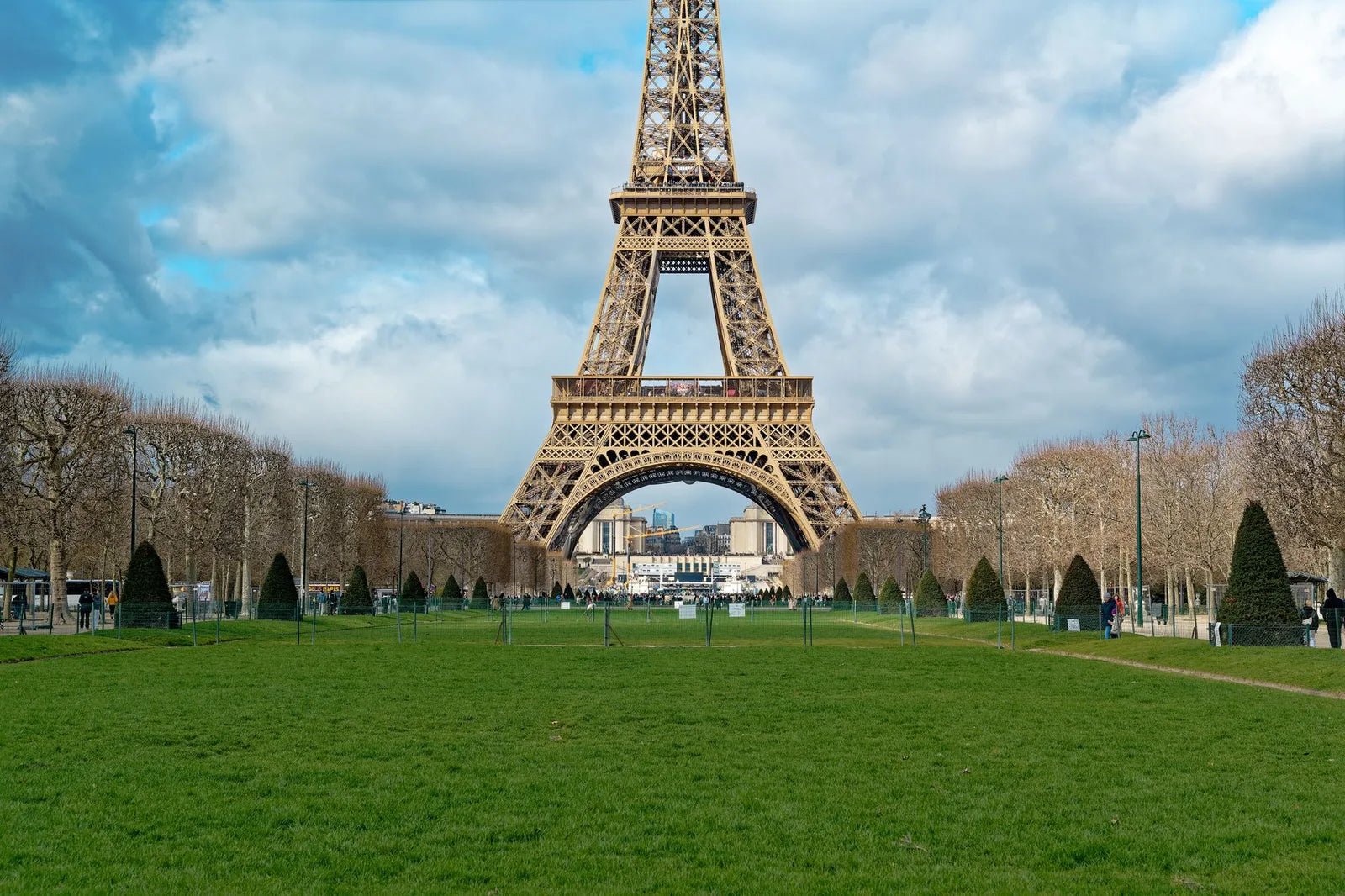
Champ-de-Mars, Paris, May 1889. The Eiffel Tower has just been inaugurated. Three hundred meters of puddled iron, completed in two years and two months by the firm of Gustave Eiffel, become the symbol of the 1889 World's Fair. Over the six months of the event, 32 million visitors walk under the central arch, ride the Roux, Combaluzier and Lepape elevators, dine in the first-level restaurants. The fair coincides with the centenary of the French Revolution and marks the industrial triumph of a still-young Republic.
That fair, like those of London in 1851, Paris in 1855, 1867, 1878 and 1900, Vienna in 1873 or Chicago in 1893, produces its own communication apparatus. Posters, brochures, postcards, fold-out maps, illustrated tickets. It is in that context that, during the 1880s, the world's fair poster emerges as a specific sub-genre of Belle Époque commercial display.
Paris 1889, the triumph of iron
The official poster for the 1889 fair is commissioned to Eugène Grasset, a Swiss artist established in Paris since 1871, today considered one of the fathers of Art Nouveau graphic design. His composition stages an allegorical Republic, dressed in classical drapery, holding a crown above the Eiffel Tower still under construction in the poster, a sign that the drawing was prepared while the Tower's construction was in full swing. Printed by Chaix in Paris, the poster runs to tens of thousands of copies.
Alongside the official poster, dozens of pavilions and firms commission their own: the Chemins de fer du Nord, which carries visitors to Paris, the Wagons-Lits Company, the colonial pavilions, the foreign sections. The Galerie des machines, 421 meters long and 115 wide, becomes a recurring subject. Its metal structure, designed by the architect Charles Dutert and the engineer Victor Contamin, hosts locomotives, steam engines, machine tools. Several posters make it their central subject, an interior view or a frontal perspective.
Paris 1900, Art Nouveau triumphant
Eleven years later, the 1900 World's Fair opens in Paris for six months. It draws 50 million visitors, an absolute record for the format. The Petit Palais and the Grand Palais are built for the occasion, designed by the architects Charles Girault, Henri Deglane, Albert Louvet and Albert Thomas. The Gare d'Orsay (today a museum) is inaugurated for the fair. The first line of the Paris metro, the Nord-Sud between Porte Maillot and Vincennes, opens on 19 July 1900.
The official poster, drawn by Pal (Jean de Paleologue, Romanian illustrator), shows an allegorical female figure surrounded by the flags of the nations. The Belle Époque poster artists take part in the event. Mucha signs several peripheral compositions, including a poster for the Bosnia-Herzegovina section, organized by the Austro-Hungarian government. Eugène Grasset delivers a poster for Suchard chocolates. Cappiello, just starting out, signs the first of his posters for Maurin Quina.
Vienna 1873, Chicago 1893, and the rest
World's Fairs are not a Parisian monopoly. Vienna in 1873, in the Prater, rolls out a system of posters in German and French, in graphic design still close to late neoclassicism. Chicago in 1893, for the World's Columbian Exposition that marks the four-hundredth anniversary of Christopher Columbus's arrival, produces its own language: American compositions blend classical allegory with the register of illustrated press from the great Midwest dailies. Saint Louis in 1904 refines that vocabulary further.
"The world's fair poster," historian Bertrand Tillier wrote in 1995, "is where public commission, the birth of modern graphic industry and mass visual consumption meet. Three conditions that rarely come together in history."
Why these posters return to the wall
World's fair posters have a rare evocative quality. They summon an imagination of nascent modernity, a faith in progress, a graphic elegance typical of the Belle Époque. In a contemporary interior, they bring historical warmth without falling into pastiche. A poster of the illuminated Eiffel Tower for the 1889 fair, framed in light wood, works as well in a classic Parisian living room as in a Scandinavian apartment.
Suggested format: 50 by 70 centimeters for allegorical compositions, 70 by 100 for monumental views (Galerie des machines, pavilion façades). Light wood or natural oak frame, echoing the woodwork of Belle Époque interiors. Avoid the matte black frame, which dampens the warm tones typical of lithography of the period. Ideal wall: a light ground, off-white or beige, that lets the ochres and reds of the posters breathe.
Three starting points
- An Eiffel Tower or Galerie des machines poster from 1889, in a documentary and precise composition. For a classic living room or a Haussmannian apartment staircase.
- A 1900 allegorical poster in the Pal or Mucha style: a female figure, flags, vegetal ornament. For an entry or a hallway.
- A foreign-fair poster (Vienna, Chicago, Saint Louis) to open the eye to the international network of fairs and to cross different graphic schools.
At Montmartre Poster, the vintage travel collection offers posters in the lineage of the great world's-fair and Parisian Belle Époque tradition. To widen the view, the vintage collection brings together the graphic languages of the late nineteenth and early twentieth century, which intersect and feed each other around these great international events.