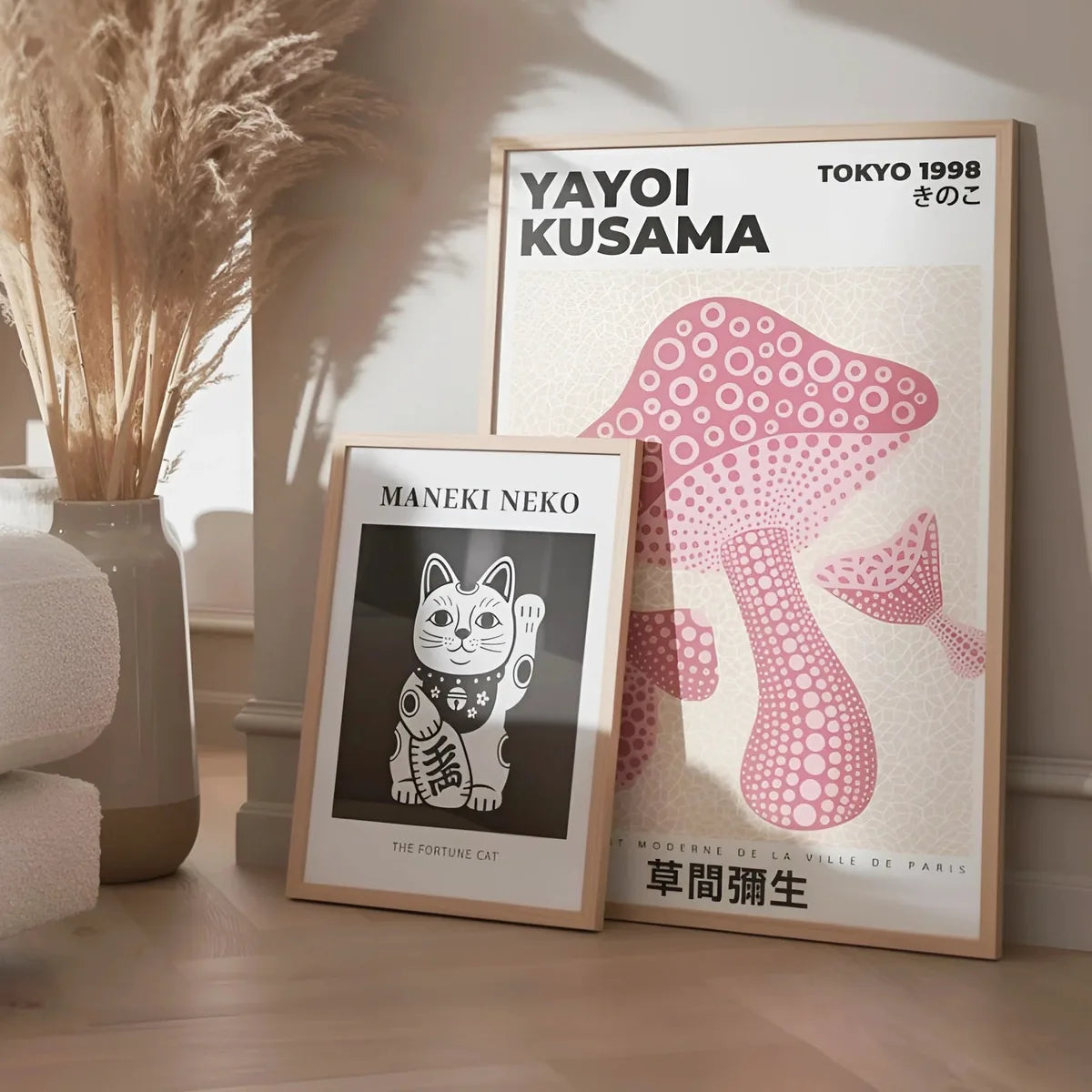
A childhood in Matsumoto, in the Japanese Alps, in the 1930s. Yayoi Kusama, born in 1929, recalls watching, at the age of ten, the pattern of the tablecloth invade the room. Dots multiplied on the walls, on her hands, on the sky through the window. That is the image she has held onto for her entire life. Seventy years later, she still lives in Tokyo, in a psychiatric institution she chose herself in 1977, and she still paints dots every day.
That continuity is rare in contemporary art. Most artists go through phases, drop one motif for another. Kusama held on to the dot and the infinity net for seven decades, the way you hold on to a useful obsession. The result is a visual vocabulary recognizable at a glance, in a museum shop in Tokyo as much as in the Tate Modern retrospective in London in 2012.
New York, 1958-1973
She landed in Seattle in 1957, then in New York in 1958, with a suitcase of drawings and minimal English. Her parents wanted her married to a textile heir in Matsumoto. She refused. In New York she lived in cold studios, painted at night, and exhibited in 1959 her first Infinity Nets at the Brata Gallery, canvases entirely covered with small white arcs on a black ground. Donald Judd, an art critic at the time, bought one of those canvases for 200 dollars.
Through the 1960s, Kusama staged happenings, painted rooms, horses and volunteer nudes with every conceivable dot. She photographed everything. She lived in direct competition with Andy Warhol, whom she accused for years of copying several of her ideas of serial repetition. When she returned to Tokyo in 1973, sick and exhausted, American art had forgotten her name. It took the Centre Pompidou exhibition in 1985 and the Venice Biennale retrospective in 1993 for her to come back to the front line.
The pumpkin, absolute signature
Pumpkins appear in her work from childhood on. Her family grew nursery crops. She drew her first pumpkins at seventeen. The motif became recurrent in the 1980s, then exploded in the 2000s with the monumental sculptures installed on Naoshima, the art island in the Seto Inland Sea of Japan. The yellow polka-dot pumpkin of Naoshima, set facing the sea since 1994, is probably today the most photographed image of contemporary Japanese art.
Why the pumpkin? Kusama has explained it: the rounded shape, the warm color, the awkwardness of the subject move her. A trivial fruit nobody really looks at, turned into a monument. The motif also works as a poster. Compositions where the pumpkin sits at the center of a single ground, yellow on purple, yellow on red, yellow on black, are the most effective to reproduce. Our piece, the yellow polka-dot pumpkin on a purple ground, is a take in that spirit, not an original work by the artist but an illustration informed by that vocabulary.
"I would like to become a flower at the side of the road," Kusama wrote in 1968. "A flower nobody looks at, but which keeps existing."
Living with a Kusama on the wall
The polka-dot motif, indoors, asks for room. A poster covered in dots, or an infinity net, does not mix well with other patterns. The rule that holds: one wall, one ground, one single large piece. The rest of the room needs to fall silent. A plain sofa, neutral walls, a simple lamp. The dots do the whole work on their own.
Format matters. Below 50 by 70 centimeters the motif loses its hypnotic force and turns into a trinket. At 70 by 100 centimeters, especially in a room where it stands alone, it shifts into another register. The frame: matte black to discipline the composition, or light wood to let it breathe. Avoid gilded frames, which fight the color of the dots.
Three works to know
- "Infinity Nets" (from 1959 on): the white nets on a black ground, or the reverse, which she still paints today in formats up to three meters.
- "Pumpkin" of Naoshima (1994): the fiberglass pumpkin installed facing the Seto Inland Sea on a pier.
- "Eyes" (1998): a composition with multiplied eye motifs, in the line of post-war Japanese Surrealism. Our reproduction of that plate ties together the artist's entire grammar.
At Montmartre Poster, the Japonisme selection brings together dots, nets, ukiyo-e prints and the visual world that has circulated for three centuries between Edo and Tokyo. See the Japonisme collection for the full range, printed on 275 gsm art paper.