
Artists
Yayoi Kusama
The polka-dot universe of the Japanese artist. From childhood hallucinations in Matsumoto to global acclaim, by way of 1960s New York.
- Born
- 1929-03-22
- Living
- Living
- Nationality
- Japanese
Yayoi Kusama was born on 22 March 1929 in Matsumoto, Nagano prefecture, Japan, the fourth child of a seed-merchant family. She began hallucinating around the age of ten: poppy fields whose flowers spoke to her, tablecloth patterns that multiplied and covered her. Her mother, authoritarian, tore up her drawings. Kusama drew anyway, in secret, hundreds of times the same pumpkin from the family's vegetable garden. The pumpkin became her lifelong motif.
After studies at the Kyoto School of Arts and Crafts, she wrote in 1955 to Georgia O'Keeffe asking for advice. O'Keeffe replied. Kusama left Japan in 1957, landed in Seattle and then New York in 1958. She was 29, broke, and invisible to the New York art scene. Her studio on East 19th Street was tiny. She painted at night, in series, her Infinity Net works: 5-meter canvases entirely covered with small white arcs that form a net with neither beginning nor end. The first show at Brata Gallery in 1959 drew the attention of Donald Judd and Frank Stella.
In the 1960s she multiplied the performances: the Naked Happenings in Central Park (1968), the Aggregation Sculptures (sofas covered with stuffed phalluses), the first Mirror Rooms (rooms entirely lined with mirrors, peopled with dots). She became a figure of the counterculture, exhibited at the Japanese pavilion of the Venice Biennale in 1966 without official authorization. But she did not sell. Andy Warhol took her ideas without crediting her (Kusama said so and the chronology backs it up), Lucas Samaras likewise. She returned to Japan in 1973, broken.
She moved in 1977 into à Tokyo psychiatric hospital where she still lives, and works at the studio across the street. Her global return began in 1989 with a retrospective at the Center for International Contemporary Arts in New York, then at the Venice Biennale in 1993 where she représented Japan. Tate Modern gave her a retrospective in 2012, the Hirshhorn Museum in 2017. Today her Infinity Mirror Rooms draw multi-hour queues in every museum that hosts them. The Yayoi Kusama Museum in Tokyo opened in 2017.
A Kusama print lives in a bright room. The black dot on yellow or red on white asks for smooth walls, no gallery wall to dilute it. A thin light oak frame or raw frameless mount suits better than an ornate frame. It belongs in a contemporary living room or a child's bedroom: the palette is joyful, the obsessive motif within everyday view.
Prints in the spirit of Kusama

Purple Polka-Dot Pumpkin Japanese Art Poster

Japanese Art Poster, Mountains Tokyo 1993, Yayoi Kusama

Pink Polka-Dot Pumpkin Poster, Japanese Art, Yayoi Kusama

Orange Polka-Dot Pumpkin Poster, Japanese Art, Black Background, Yayoi Kusama

Orange Polka-Dot Pumpkin Poster, Japanese Art, Pink Background, Yayoi Kusama

Polka-dot Blue Pumpkin, Japanese Art Poster, Yayoi Kusama

Polka-dot Orange Pumpkin, Japanese Art Poster, Purple Background, Yayoi Kusama

Polka-dot Yellow Pumpkin, Japanese Art Poster, Purple Background, Yayoi Kusama

Polka-dot Yellow Pumpkin, Japanese Art Poster, Low-angle View, Yayoi Kusama

Polka-dot Orange Pumpkin, Japanese Art Poster, Low-angle View, Yayoi Kusama

Polka-dot Yellow Pumpkin, Japanese Art Poster, Exhibition Style, Yayoi Kusama

Poster Fire-Orange Polka-Dot Pumpkin Japanese Art

Poster Yellow Polka-Dot Pumpkin Signed Japanese Art

Poster Infinite Multicoloured Polka Dots Japanese Art

Poster Polka-Dot Eyes Yellow and Red Japanese Art

Poster Red Woman's Face Polka Dots Japanese Art

Leopard in the Colorful Jungle Japanese Art Poster, Yayoi Kusama

Polka-Dot Fish on Green Background Japanese Art Poster, Yayoi Kusama

Polka-Dot Crab on Blue Net Japanese Art Poster, Yayoi Kusama

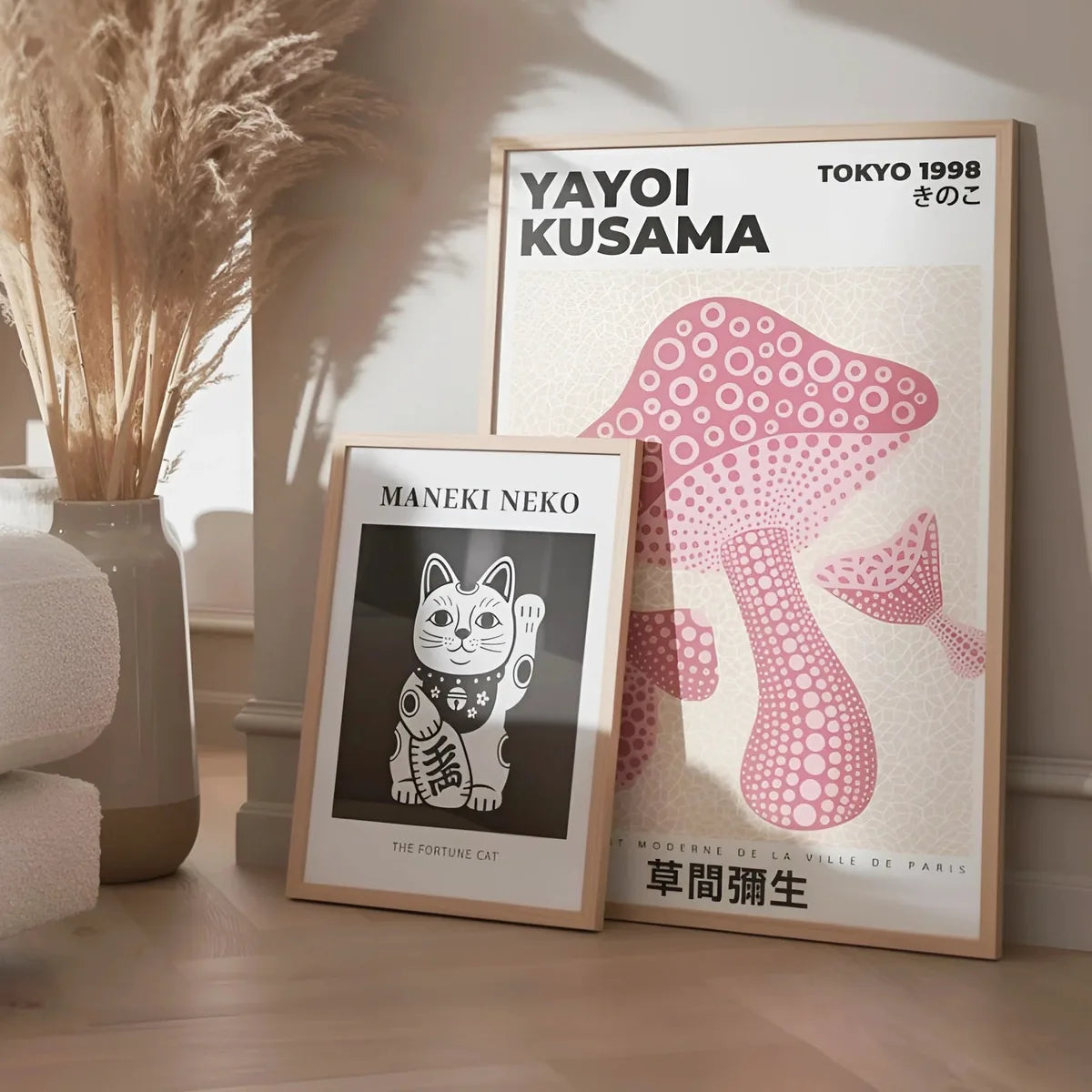
Pink Polka-Dot Mushroom Japanese Art Poster, Yayoi Kusama

Multicolour Polka-Dot Mushrooms Japanese Art Poster

Red Mushrooms on Blue Net Japanese Art Poster
