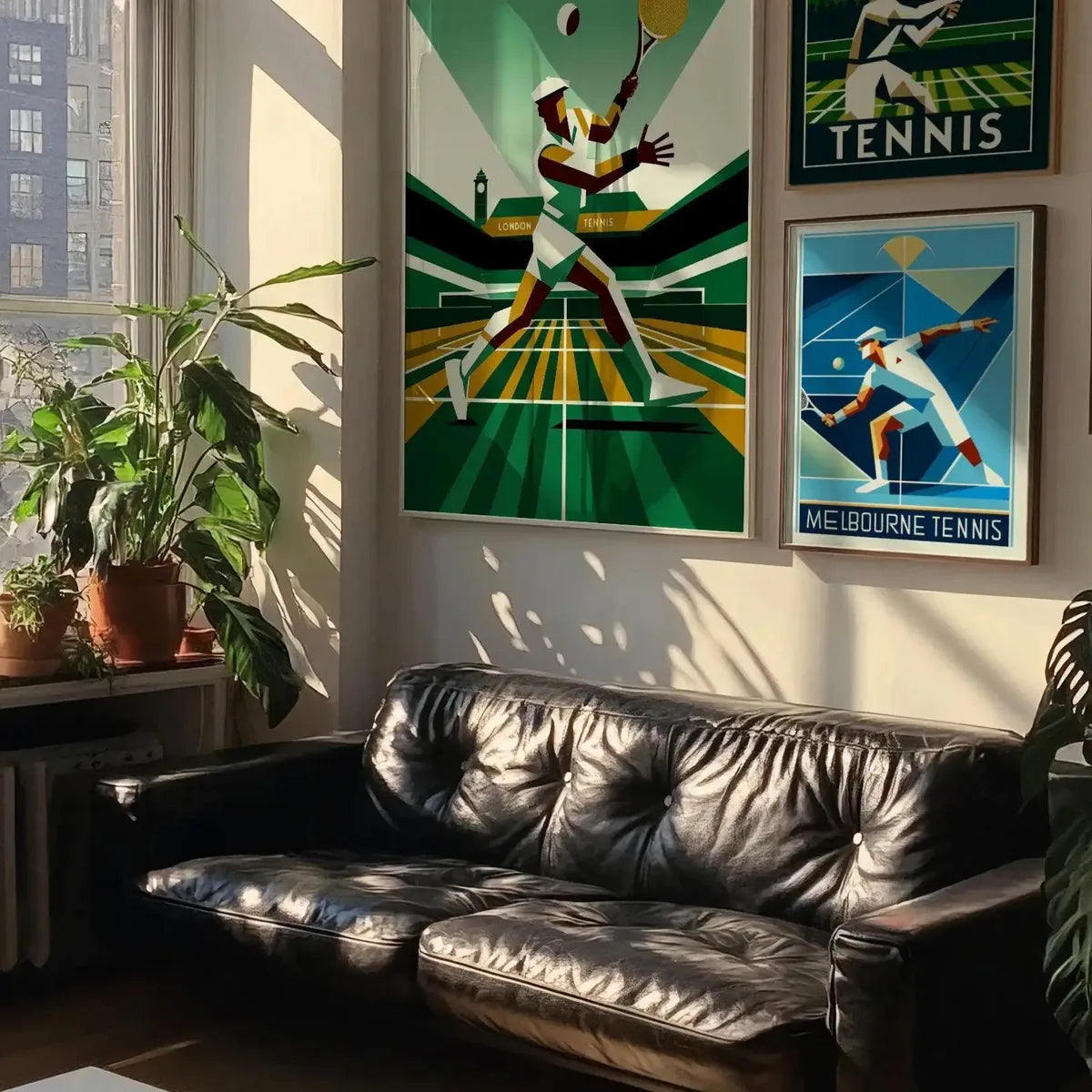
A New York match begins before the first serve. It begins on the subway, among silhouettes crossing Queens in dark caps, then continues through stadium geometry, white lines and the deep blue court. That sequence explains why New York and tennis make such a rich subject for poster art.
Two addresses, two visual worlds
Before Flushing Meadows, the American championship was played at Forest Hills. Closer stands, grass and the West Side Tennis Club created an almost residential image of the sport. The move to Flushing Meadows in 1978 changed the scale. The tournament entered New York’s monumental landscape, near the Unisphere and the remains of the World’s Fair.
For a poster artist, the contrast is useful. Forest Hills suggests muted greens, wooden rackets and colour fields inherited from the 1920s through the 1970s. Flushing Meadows calls for diagonals, electric light, court blue and more direct typography. Both stories can coexist without becoming interchangeable.
When movement becomes a graphic sign
Tennis can be read in a fraction of a second. A turned shoulder announces the serve. One suspended leg suggests a volley. A racket behind the body already describes the backhand. Poster art simplifies those movements into a silhouette that remains legible from a distance.
The best tennis poster does not freeze a player. It preserves the tension of the point in a single shape.
New York adds its own vocabulary: the avenue grid, beams of light, metal steps, vertical buildings and the Statue of Liberty. The danger is to stack every symbol. A strong composition chooses one and lets the sporting gesture occupy the foreground.
From wall to garment
Tennis culture has always travelled between court and city. Polos, sweatshirts, caps and bags make club codes visible far beyond the stands. On a garment, the drawing must become more compact than on a poster: few colours, a clear shape and typography that stays readable in motion.
That dialogue sits at the centre of the New York Tennis collection. Posters carry sporting graphic tradition into the home, while garments return its signs to the street. Two supports, one scene: New York viewed from the baseline.
![Sweat à capuche New York Tennis Monumental 49. design textile unisexe [color:green] [view:front]](https://cdn.shopify.com/s/files/1/1061/4862/6757/files/2cb89ba95904a520f86ce637e6ae37d9_800x.png?v=1788135115&width=100&height=150&crop=center)
![T-shirt New York Tennis Monumental 48. design textile unisexe [color:green] [view:front]](https://cdn.shopify.com/s/files/1/1061/4862/6757/files/89fd626a2c9a2818acb60356a3bfd336_800x.png?v=1788135093&width=100&height=150&crop=center)
![T-shirt New York Tennis Monumental 47. design textile unisexe [color:navy] [view:front]](https://cdn.shopify.com/s/files/1/1061/4862/6757/files/1ddca3b36d8900d36a14a745152adca6_800x.png?v=1788135070&width=100&height=150&crop=center)
![T-shirt New York Tennis Monumental 46. design textile unisexe [color:black] [view:front]](https://cdn.shopify.com/s/files/1/1061/4862/6757/files/47263dac828764e4c7bae83c62eb25a0_800x.png?v=1788135047&width=100&height=150&crop=center)