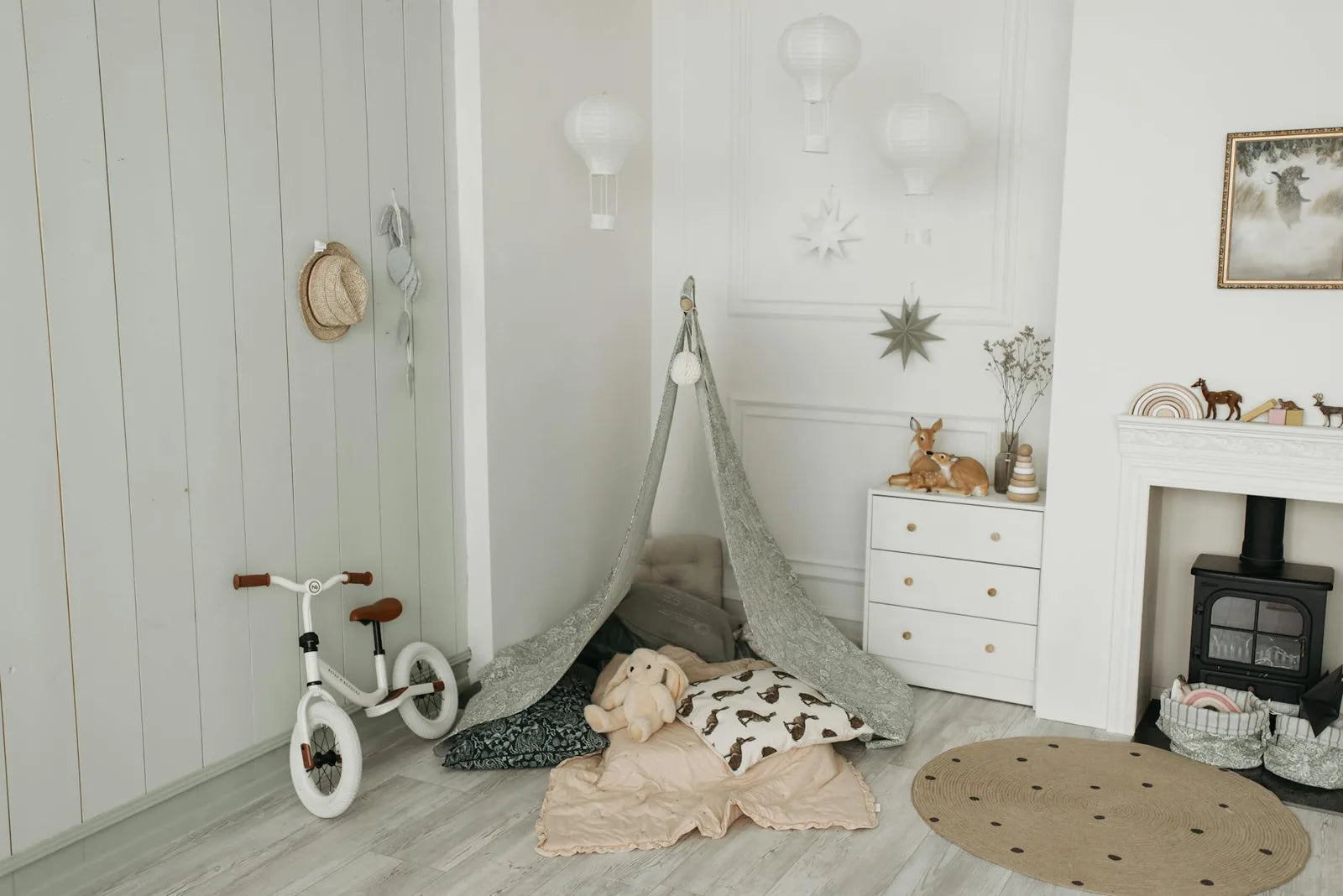
A dresser in a bedroom, one evening. Above it, a poster of cats among flowers, drawn flat, in a naive-art spirit. The child looks at it before sleep, the adults find it lovely on waking. The animal poster has that rare quality: it speaks to both ages at once, as long as you do not choose it too babyish or too solemn. Everything turns on the style of the drawing and the softness of the palette.
The animal runs through the whole history of the image, from the eighteenth-century cabinet of curiosities, with its natural-history plates, to the animal friezes of children’s rooms. Between the two lies a huge range: from learned realism to the graphic silhouette, from the seashell to the whale. It is that breadth that lets a single poster travel from one room to another over the years.
Naive or realistic, two schools
The naive animal, drawn flat, in blocks of color and simple shapes, goes naturally toward the child’s room and cheerful spaces. It reads from afar, never unsettling, and carries bright colors well. The realistic animal, a natural-history plate or a detailed silhouette, holds better in a living room or office, where it strikes the cabinet-of-curiosities note. Between the two, the graphic silhouette, a gorilla in flat orange for instance, bridges the gap: stylized enough for a bedroom, strong enough for an adult wall.
The palette, the key to age
- Baby’s room: powder pink, sea green, beige, round shapes and great calm.
- Child’s room: clear colors but few of them, two or three shades at most.
- Living room: earthy tones, ochre, terracotta, black, for a realistic animal or a silhouette.
- Office: a single graphic animal, monochrome or two-tone, with nothing cluttering around it.
Hanging without tipping into the twee
The trap of the animal poster is the endearing pile-up: six cute animals in a row, and the room turns into a yogurt pot. A single strong piece, well centered, beats a collection. In a child’s room, lower the hanging height to the child’s eye level, around 1.20 meters, so they can really look at the image. As for framing, light wood or a white frame softens the whole in a bedroom, while a black frame lends gravity to a realistic animal in the living room. Always leave a little empty wall around it: the animal needs space to exist.
A good animal poster grows with the child. Chosen for its drawing and not its subject, it moves from the bedroom to the hallway without ever looking babyish.
At Montmartre Poster, the animals and kids collections bring together naive cats, minimalist jellyfish, graphic silhouettes and sea creatures, printed on 275 gsm art paper. Enough to compose a child’s room that will tire neither the child nor the parents.