Poster size is the most frequent mistake in wall decoration. Too small, it gets lost in the wall and looks like a postage stamp. Too large, it crushes the room and tires you in the long run. The right size is neither intuition nor taste: it is calculated, from three measurable parameters. Once those parameters are known, you almost always land on the right format without hesitation.
Three proportion rules structure that calculation. The first derives from the wall-poster ratio: the poster occupies between 50 and 70 percent of the target zone width (wall or furniture). The second derives from viewing distance: the format must be readable at the average distance from which the zone is usually seen. The third derives from ceiling height: low ceilings call for horizontal formats, high ceilings carry vertical ones.
Rule 1: wall-poster ratio
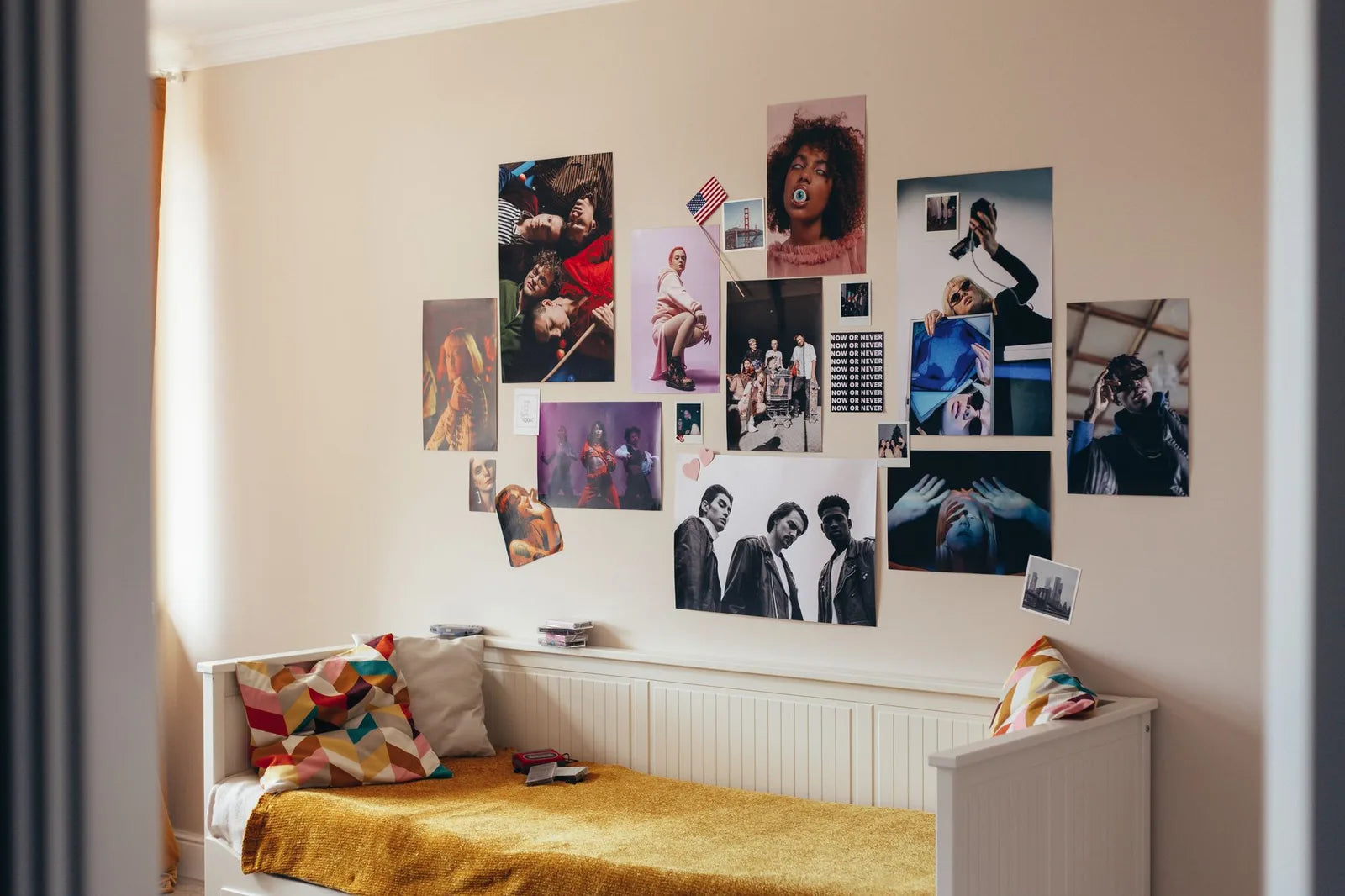
Measure the width of the zone to dress. If it is a free wall, measure the total width. If it is above a piece of furniture, measure the furniture width (the poster must talk to it, not to the whole wall). The poster occupies between 50 and 70 percent of that width. Below 50 percent, it floats. Above 70 percent, it crushes. Good proportions: above a 180 cm sofa, a 70x100 (width 70 cm = 39 percent of the sofa, below the threshold but compensated by height) or a horizontal 50x70 (width 70 cm). Above a 220 cm sideboard, a 100x70 or two spaced 50x70s.
Rule 2: viewing distance
Measure the distance from which you usually look at the wall. In a hallway crossed 1.50 meters from the wall, a 30x40 is plenty (and a 70x100 is too close to be seen entire). In a living room where the sofa sits 3 meters from the wall, a 50x70 minimum is necessary. In a double living room with 5 meters of step-back, the 70x100 becomes the base format and the 100x140 comes into its own.
Rule of thumb: the poster diagonal should be about 1/3 of the viewing distance. A 50x70 poster has an 86 cm diagonal, optimal at about 2.60 meters. A 70x100 has a 122 cm diagonal, optimal at about 3.70 meters. A 30x40 has a 50 cm diagonal, optimal at about 1.50 meters. These distances are not absolutes but useful orders of magnitude.
Rule 3: ceiling height
Measure the ceiling height. Below 2.40 meters (typical of 1970-1990 construction), favor horizontal formats: 30x40 and 50x70 landscape, even 70x100 landscape. Vertical formats with a low ceiling emphasize the sense of crushing. Between 2.40 and 2.80 meters, both orientations work. Above 2.80 meters (Parisian Haussmann, lofts), vertical formats come into their own and can climb to 100x140. Do not hesitate to go large in high volumes: this is exactly what those volumes call for.
Practical cases
- Above a two-seat sofa (160 cm): a single 50x70, centered, 25 cm above the back.
- Above a three-seat sofa (180-220 cm): a centered 70x100, or a trio of aligned 30x40s.
- Above a double bed (160 cm): a horizontal 70x100, centered above the headboard.
- Narrow hallway (100 cm wide): a series of 30x40s aligned at eye level, 8-10 cm spacing.
- Entry with a 200 cm clear wall: a vertical 70x100, centered at eye level.
- Dining room with a 200 cm sideboard: a 70x100 or two 50x70s.
- Office above a 120 cm desk: a vertical 50x70 centered, 30 cm above the desk.
- Kitchen above a counter (60 cm available between cabinets): a horizontal 30x40.
The right format is not bought on instinct. It is calculated from three measurements. Less poetic but much more effective.
And oversized formats
Panoramic formats (40x100, 50x100) and very large formats (100x140, 100x150) answer specific cases. The panoramic works above a long sofa or table, or in a series of two or three. The 100x140 is a strong format: it does not go just anywhere. Free wall of 3 meters minimum, viewing distance of 4 meters minimum, ceiling height of 2.80 minimum. Within those conditions, it is the most powerful format available. Outside them, it crushes the room.
At Montmartre Poster, every subject in the full selection is available in standard formats (30x40, 50x70, 70x100). For custom choices or proportion questions, see the FAQ, which gathers the most frequent cases. All formats are compatible with the framings on the frames and accessories page.